Wednesday, February 3, 2016

Banding Birds at Sandy Point National Wildlife Refuge 2016


Mangrove Cuckoo all banded
Sandy Point National Wildlife Refuge was established in 1984. Since its beginning the refuge strives to protect endangered species, study those species, and encourage the public to become aware that this protected area provides a healthy environment for people, wildlife and marine animals.

Northern Waterthrush
As part of the refuge scientists and volunteers study marine animals, turtles and wildlife species. Through these long term studies data is collected that help us all understand migration, reproduction, degradation, environmental impacts and give us tools to devise long term protection methods.
Caribbean Elaenia
Sandy Point National Wildlife Refuge has a commitment to foster public understanding, appreciation and the opportunity to enjoy hiking, wildlife observation and nature photography.

Common Ground Doves beautiful head feathers

Bird banding started in the 16th century when one of Henry IV’s Peregrine Falcons escaped; because the bird was banded(ring around its leg) it was recognized when it showed up in Malta. Henry got his bird back and banding took off. Today millions of birds are banded around the world.

Banding Station
When it comes to banding birds the Refuge has a well defined and executed scientific mission and is part of a planned long term study. We use metal bands that have a unique identification number that is etched on and recorded when a bird is banded. This information is shared through a central data base run by the USGS.  If we recapture the birds at some point in the future we can examine our records and evaluate the change that has occurred over the time passed.
Prairie Warbler
Bird banders gather scientific information that benefit the birds, their habitat, and conservation in general. We can determine the health of the populations, the longevity, their age, their reproductive status, and their migratory patterns. All banders must go through rigorous training before they are allowed to handle or band birds because the birds safety is our first priority.
Mist Nets
At the Refuge we begin by setting up the mist nets which are typically made of nylon or polyester mesh and suspended between two poles. When properly set up the nets are invisible to the birds. Mist nets can only be deployed by scientists who have been licensed, permitted and trained. Ordinary citizens could face jail time if they attempted to install any nets.
Holding area for birds waiting to be processed
When birds land in the nets they are removed as safely and quickly as possible. They are put in bags to reduce their anxiety and quickly taken to the banding station for weighing, measuring, and banding. Their well-being is our top priority and their safety is our primary objective.
Weighing the bird
Measuring the bill

Measuring the wing on a Common Ground Dove

Measuring the tail on a Northern Waterthrush

Looking for pin feathers on a Northern Waterthrush
After examining them for molting feathers, brood patches, age, sex, weight, beak, wing and tail lengths we let them go.  We try to keep their time in captivity to a minimum. Recaptureing birds help us communicate to the public and decision makers the conservation value of bird banding and its negligible impact upon those birds.
Checking for molt on a Common Ground Dove
Banding data helps researchers understand the life history and survival rates of juvenile and adult birds, population dynamics, migration, status of species of special concern, and disease transmission.
Caribbean Elaenia ready for release
In some areas of the country kids who attend public banding sessions become inspired to become birders, scientists, ornithologists or biologists. Even those who don’t pursue birds as a field of interest may grow up to be policy makers making decisions that dramatically affect the well being of birds. Public outreach and teaching the importance of conservation and study does help to protect all birds that reside here or transit through during migration.
Green Throated Carib which we release immediately and don't band
i hope this helps those that may have been wondering why we band birds.
Sunrise at Sandy Point Refuge
See ya next week

Wednesday, January 27, 2016

Slow day

Greater and Lesser Yellowlegs at Sandy Point
Too many things going on today to spend much time working on the blog. My original idea got scrapped temporarily...and the photos i had taken were mediocre so this will be a bit of a hodge podge.
Atlantic Ray

Omar Khayyam always moves me so the next two are by him.

LI
The Moving Finger writes: and, having writ,
Moves on: nor all thy Piety nor Wit
Shall our it back to cancel half a Line,
Nor all thy Tears wash out a Word of it.
Sunrise at Sandy Point

LII
And that inverted Bowl we call The Sky,
Whereunder crawling coop't we live and die,
Lift not thy hands to IT for help---for IT
Rolls impotently on as Thou or I.
3 master hanging out on the north shore
The Doomsday clock is at three minutes to Twelve.
Blooming Century Plant

Canada has a single payer health plan that provides quality care for half the price of the same care in the US.  If you want to learn more check out this link.
http://www.commonwealthfund.org/interactives-and-data/us-compare-interactive#?ind=1&compare=CAN
Looking at Sandy Point from the water
Healthy friendships maintain face-to-face communication.
Smooth Trunkfish
Do you ever read any articles about WHY think tanks like to shape conversations about issues that affect all of us?
Anyone know what this is called?
Some on the right point to the Quran as being violent but what about the Bible?

"If a man commits adultery with another mans wife, both the man and the woman must be put to death." Leviticus 20:10

"Everyone who would not seek God was to be put to death, whether small or great, whether man or woman." Chronicles 15;12-13
Hamms Bluff

The trade winds are cooling off our sunny and warm climate in St. Croix today. i know you wish you were here and so do we.

See ya next week.


Wednesday, January 20, 2016

St. Croix's Caribbean Waterbird Census

Wilson's Plover's
Devotion is a word the religious use to describe a profound dedication to observance. In my world i am profoundly devoted to observing the wondrous life of birds. In honor of this observance myself and a partner joined fearless birders all across the Caribbean this past week to collect information about the birds that inhabit our wetlands.
Wilson's Plovers hiding
The Caribbean Waterbird Census collects data that is used to create programs for monitoring, protection and conservation of all birds that either live in the islands or pass through on migration. These places are amazing in their own right and are cherished by birds and humans alike. 
Smooth-billed Ani
Smooth-billed Ani
Birds go to the beach too and the wetlands that provide protection for us from storms also provide nourishment and shelter for the birds. The mud and tidal flats that can provide food for birds and humans also contributes to local economies by being great birding spots for tourists.
Yellow-crowned Night Heron

American Kestrel
Through the regional collection of data the Caribbean Waterbird Census is able to “learn more about the distribution, status, and abundance of waterbirds in the Caribbean in order to improve science-based conservation planning and management of these beautiful birds and their habitats. The group aims to increase awareness, build capacity, and engage non-governmental organizations, government agencies, communities, and volunteers in wetland monitoring and conservation. Ultimately, they want to identify and ensure that as many important wetland sites as possible are conserved and monitored.”
Hope the Whimbrel
As more and more islands have become developed the wetlands are being reduced in size leaving precious few areas for the birds to use. Not only are their feeding grounds being destroyed the impact of invasive species, hunting, and sea level rise due to global climate change impacts their survival. As their source of food diminishes and their refueling stops get eaten up by development their numbers also decrease. 
Common Gallinule
By opening the eyes of island residents birders and scientists hope to try and protect the habitats these birds need to survive. 
Little Blue Heron shaking out its feathers
Little Blue Heron back to normal
Birds are breathtaking. Not only are they uplifting through just the casual sighting, they have managed to entice millions of birders all over the world to express jubilant excitement when a new bird no one has seen drops in. For the most inexperienced birder to the old die-hard birds never cease to amaze. Once you are hooked it is very difficult not to notice them every day of your life.
American Oystercatcher
St. Croix has a lovely variety that changes during migration. If you haven’t had the opportunity to observe birds it is never too late. You can start at your own house by spending as little as 5 minutes a day learning the birds that use your yard. Take a chair and sit outside with a pair of binoculars. Use a notepad to jot down what you saw and if you are really enthusiastic get yourself an account at ebird.org and contribute to the science of bird distribution.
Pearly-eyed Thrasher


Green Heron
i guarantee that if you spend any time at all watching birds you will never stop watching birds.
Bananaquit


Antillean Bullfinch female
See ya next week

Wednesday, January 13, 2016

Self-compassion

Have you ever given yourself a shellacking for some painful failure to perform or your inability to live up to your expectations? We all experience those meltdowns when a mistake we made caused us to think less of ourselves…but was this reckoning healthy or did it just plunge us into an internal meltdown?

According to research done by Kristen Neff, Ph.D there is nothing motivating about beating yourself up because you failed. i remember growing up one of my father’s favorite expressions was “It’s not the end of the world.” He would use this line to defuse some situation we considered disastrous. If we had gotten a bad grade or broken something beloved by another family member he would always caution us to understand that pitfalls were just a part of life. If we wallowed in self-loathing instead of moving on it would only plunge us into an agony of self doubt  which he thought was a waste of time

So i was pleasantly surprised to find that self-compassion is just as rewarding and maybe even healthier than high self esteem.  According to Neff there are three components of self-compassion.

Self-kindness: Being kind, gentle and understanding with yourself when you’re suffering.

Common humanity: Realizing you are not alone in your struggles. When we’re struggling, we tend to feel especially isolated. We think we’re the only ones to experience loss, make mistakes, feel rejected or fail. But it is these very struggles that are part of our shared experience as humans.

Mindfulness: Observing life as it is, without being judgmental or suppressing your thoughts and feelings.

One of the things my father’s line “It’s not the end of the world,” taught us was to understand that yep we made a mistake, we are embarrassed and vulnerable. Luckily, he and my mom gave us an amazing ability to bounce back. That miracle of self-compassion, instead of making us feel bitter and wounded gave us a surprising fortitude to pluck ourselves off the ground and move on.
According to Wikipedia “self-compassionate individuals experience emotional resilience, social connectedness, optimism, happiness, and life satisfaction and seem to have less self-criticism, depression, anxiety and disordered eating attitudes. Self-compassion offers the same mental health benefits as self-esteem, but with fewer of its drawbacks such as narcissism, ego-defensive anger, inaccurate self-perceptions, self-worth contingency or social comparison.”
According to Neff there is an easier way to self-motivate. Instead of criticizing yourself ceaselessly, forgive yourself and prove that this was just a small glitch in the whole rest of your life. Leave all those negative thoughts behind…its not the end of the world.
See ya next week.


Wednesday, January 6, 2016

St. Croix's Cane Bay

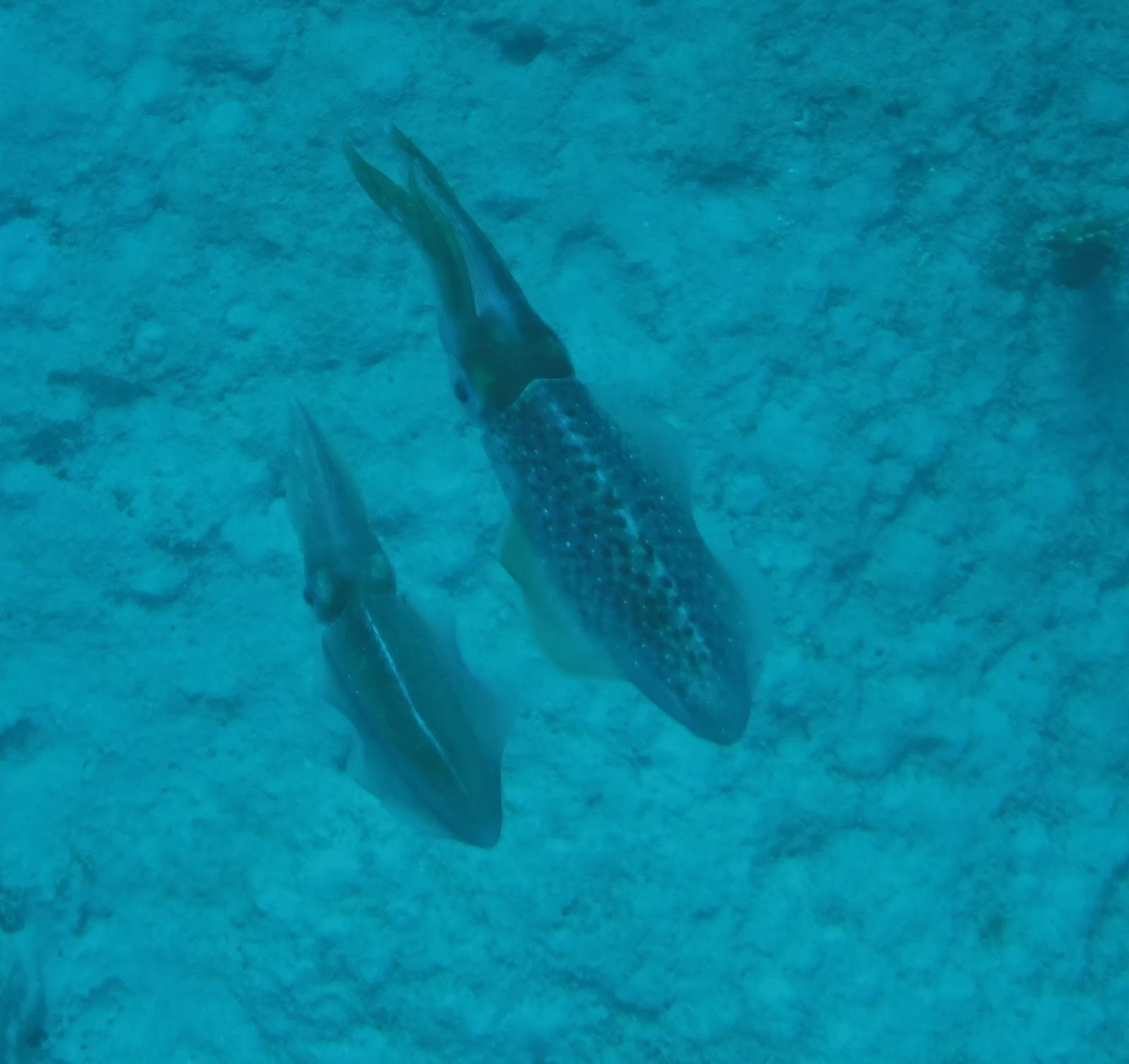
Squid
Have you ever noticed that some places close to home have an uncanny ability to drag you back time after time? For over 30 wonderful years i have been swimming regularly at Cane Bay. To say i'm devoted or i'm grateful is not the sentiment i wish to convey. What i really want is for everyone i know to experience its magic.
Green turtle and Squid on the right
Just this morning a group of us swimmers exploded into the water in a frenzy to warm up as quickly as possible. You should actually be laughing at this last sentence because the water temperature here is 80 degrees...we think its freezing when compared with a month ago when it was 84 degrees. Yes you can laugh again.

For some reason we haven't been able to figure out why the water is colder close to shore.  Three times a week we groan, we moan, we throw our arms out and shrug our shoulders, we slowly inch in while we luxuriate in the warmth of our upper bodies trying to put off the moment when we expose it to the staggering cold. Laugh now.
Sand Eels
Its definitely eye-opening, but the minute we swim out over the reef this surge of warmth envelopes us and we are home. i think we all search for that warming moment to finally feel one with the ocean. Some days the water quality is jaw-dropping, a crystal clear stunning beauty luring us forward with all her charms and other days we can hardly see the bottom.

Cane Bay is a unique spot because it is semi-protected from the north east swell. The ocean can look horrible, white caps, wind blown, nasty on the north shore and just around the corner Cane Bay is calm and swimmable. There are really very few days during the year when we can't swim.
Clada and Green turtle
This morning it was breathtaking. Cane Bay was so clear you could see all her secrets from the surface. There was no need to be down on the bottom because she couldn't cover up. i don't know if it is just me but on days like this the fish seem to be confessing all their behind the scenes actions. It is as if they tell you to watch them, follow them, enjoy them and experience how they can blend in. It's like they are talking to you, letting you in on their hidden charms.
Foureye Butterfly Fish
Some days i think the fish know us. They will turn sideways and flash in a provocative manner, or kind of nod their bodies and change to tantalizing colors. The fish are so thrilling and hypnotic as they glide around the coral and sponges it makes it tough to break away and get back to the business of exercise.

The turtles are just as bad. Some days they don't want you near them and other days they can't get enough of you. This morning they were shameless, showing off and provoking us to follow them. Five different green turtles egged us on, all of them seemed to crave our attention and we obliged.

You know i never get tired of swimming out there. Lots of people think we are crazy but how can you stop going when its never the same. There is always something mind-blowing that you never saw before. Some new jellyfish, a new creature that appears out of nowhere,  some glop of goop that turns out to be coral sperm, or a dolphin, a whale, an octopus, or squid that change colors. You never know what the next time you go swimming will offer up.

Cane Bay is one of those places that never loses its appeal and the best thing about it is its free. All you have to do is get to St. Croix, drive to Cane Bay and jump in. Nobody is going to charge you to experience this treasure...and i do mean spectacular treasure.

All the pictures were taken this morning...different turtles and different squid.

See ya next week.